
Cloud chatbots are easy to demo and hard to trust with internal notes. RAG means Retrieval Augmented Generation: before the model answers, you fetch a few relevant chunks from your files and pass them as context.
Ollama runs open models on your machine (Llama, Mistral, and others). ChromaDB is a small local vector database—it stores embeddings and finds similar text.
This tutorial is Python 3 only. You build two scripts:
| File | Role |
|---|---|
ingest.py | Read Markdown files → chunks → embeddings → Chroma |
ask.py | Your question → retrieve chunks → Ollama answer |
Each file is built in parts (A, B, …) below, plus a full copy-paste version at the end. You also need bash to install Ollama and Python packages.
Works on Linux or macOS. You do not need Cursor, Claude, or Codex to follow along—but the same corpus is useful later if you expose it through MCP or another tool.
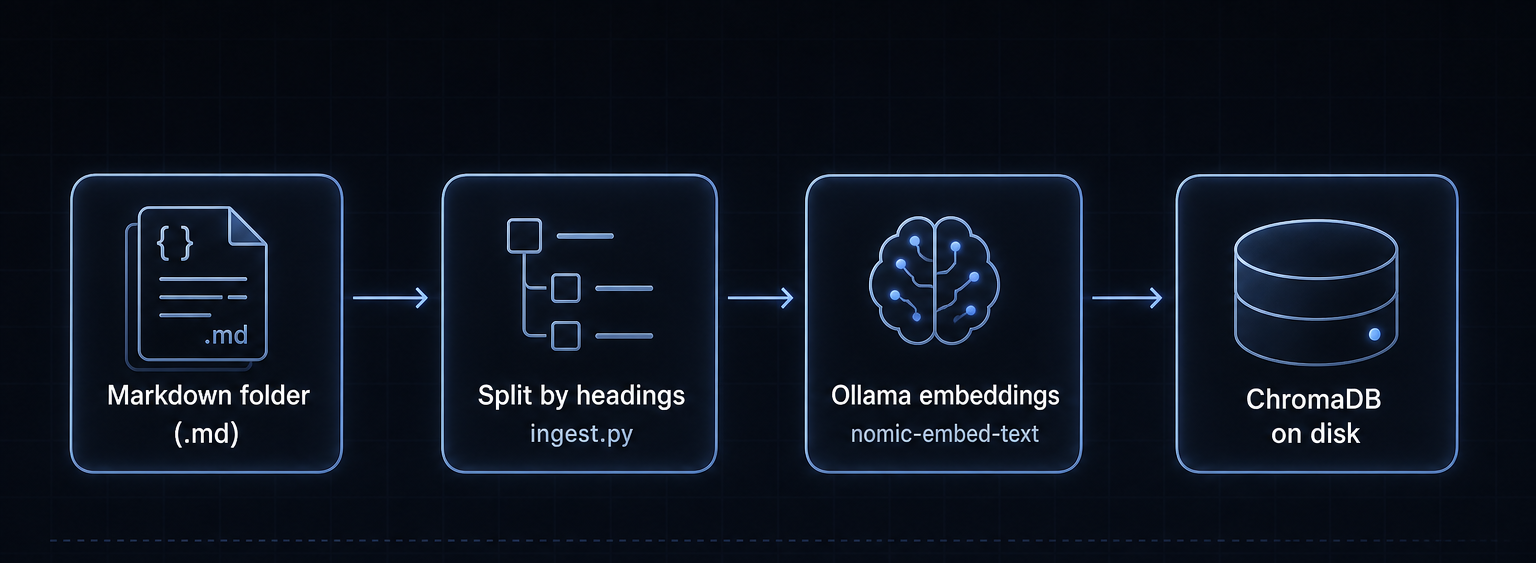 Pipeline overview:
 ingest.py builds the index once; ask.py retrieves chunks and calls Ollama whenever you have a question.
How the pipeline fits together
Two steps, two scripts. You run ingest.py once (or again when files change). You run ask.py whenever you have a question.
flowchart LR
  subgraph once [Run once: ingest.py]
    MD[(Markdown folder)]
    MD --> CHUNK[Split by headings]
    CHUNK --> EMB1[Ollama embeddings]
    EMB1 --> VDB[(ChromaDB on disk)]
  end
  subgraph repeat [Run anytime: ask.py]
    Q[Your question]
    Q --> EMB2[Same embed model]
    EMB2 --> RET[Top K chunks]
    RET --> VDB
    VDB --> CTX[Build context]
    CTX --> LLM[Ollama llama3.2]
    LLM --> A[Answer]
  end
Ingest = write the index. Ask = search the index, then generate an answer. No API keys either way—Ollama listens on localhost:11434.
sequenceDiagram
  participant You
  participant ask_py as ask.py
  participant Chroma as ChromaDB
  participant Ollama

  You->>ask_py: question
  ask_py->>Ollama: embed question
  Ollama-->>ask_py: vector
  ask_py->>Chroma: nearest chunks
  Chroma-->>ask_py: 4 text snippets
  ask_py->>Ollama: prompt + context
  Ollama-->>You: answer
RAG vs chatting without your files
A plain LLM has no access to your notes—it guesses from training data. RAG retrieves snippets first, then answers from that context.
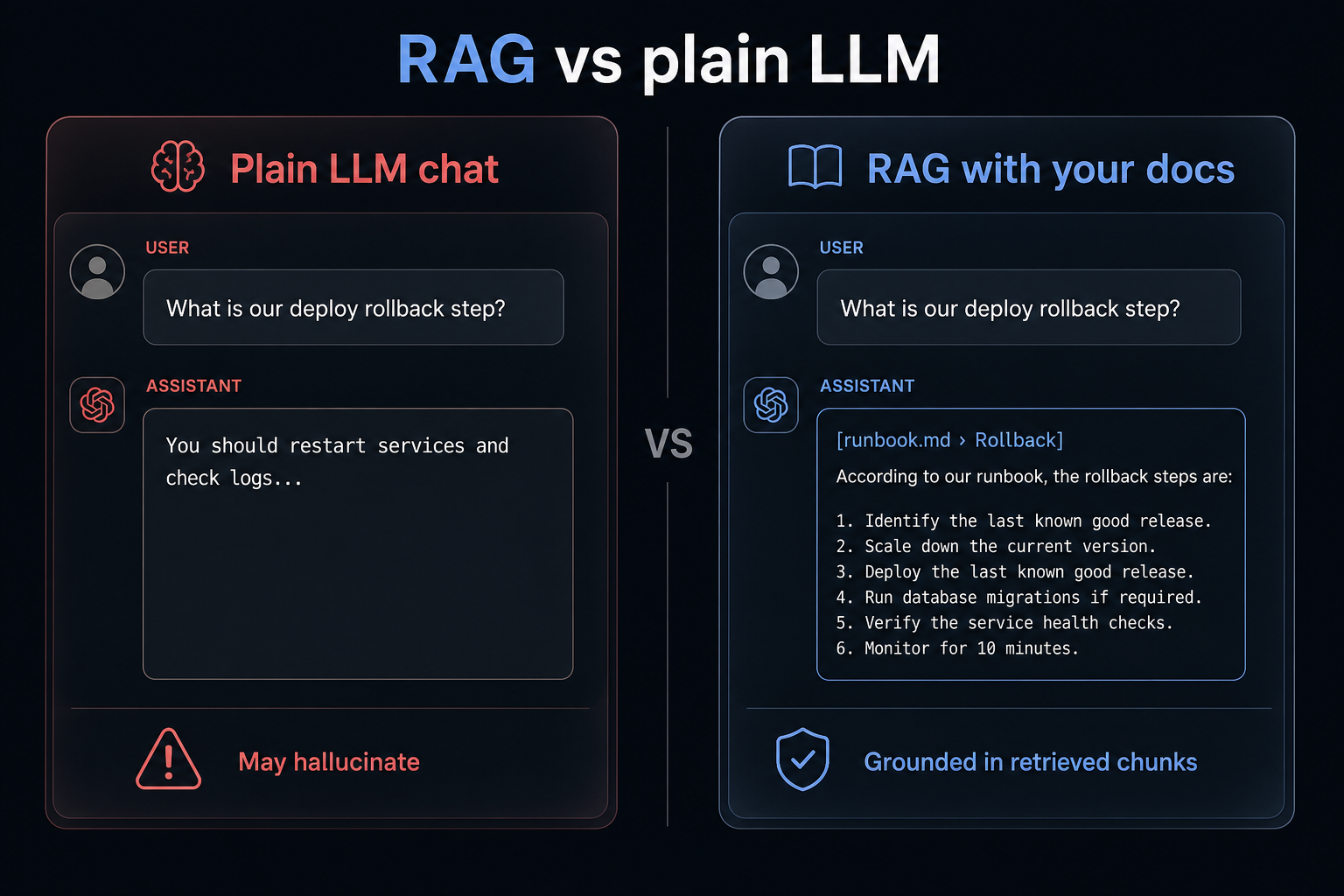
Example prompt sent to Ollama (after retrieval)
```text Answer using only the context below. If the answer is not there, say so. Context: [runbook.md › Rollback] ...chunk text... Question: What is our deploy rollback step? ``` The `ask()` function in Part B builds this string automatically from the top `TOP_K` chunks.Before you start
- Python 3.10+ — check with
python3 --version. - Ollama — install from ollama.com, then pull two models:
1
2
ollama pull nomic-embed-text
ollama pull llama3.2
- A folder with Markdown files (
.md). Example: copy a few_posts/from this site into./docs_corpus/.
Install Python libraries:
1
pip install chromadb httpx
Create two empty files:
1
2
ingest.py
ask.py
ingest.py — Part A: settings
1
2
3
4
5
6
7
8
9
10
11
12
13
14
# ingest.py — Python 3
import os
import re
from pathlib import Path

import chromadb
import httpx

CORPUS_DIR = Path("./docs_corpus")
CHROMA_DIR = "./chroma_store"
COLLECTION = "my_docs"
EMBED_MODEL = "nomic-embed-text"
OLLAMA_URL = "http://localhost:11434"
CHUNK_SIZE = 1000
Point CORPUS_DIR at your Markdown folder.
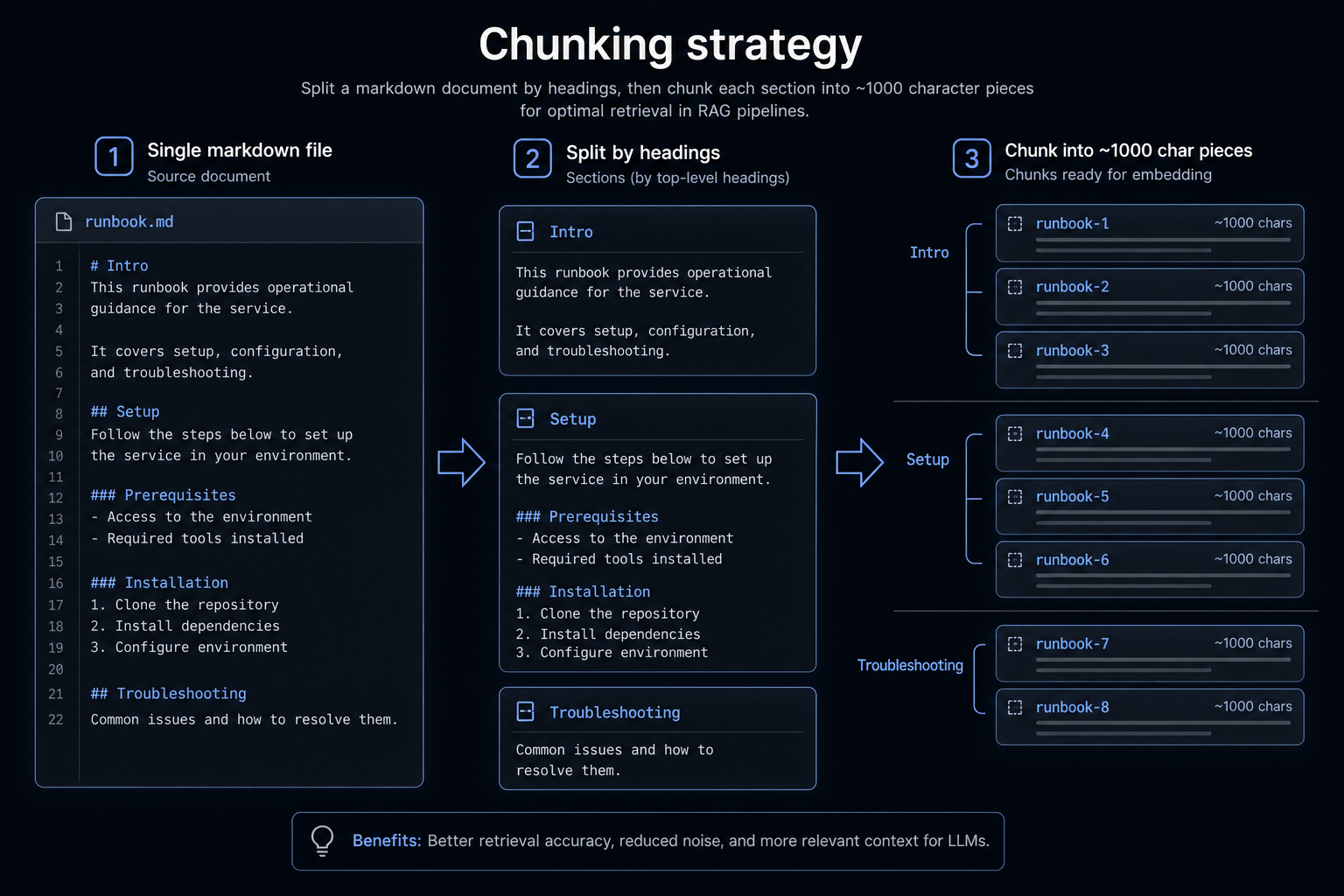
ingest.py — Part B: split Markdown into chunks
Code blocks should stay in one piece when possible. This simple splitter breaks on headings, then on character length.
1
2
3
4
5
6
7
8
9
10
11
12
13
14
15
16
17
18
19
20
21
22
23
24
25
def split_markdown(text):
    parts = []
    current_heading = "intro"
    buffer = []

    for line in text.splitlines():
        if line.startswith("#"):
            if buffer:
                parts.append((current_heading, "\n".join(buffer).strip()))
                buffer = []
            current_heading = line.lstrip("#").strip()
        else:
            buffer.append(line)

    if buffer:
        parts.append((current_heading, "\n".join(buffer).strip()))

    chunks = []
    for heading, body in parts:
        if not body:
            continue
        for i in range(0, len(body), CHUNK_SIZE):
            piece = body[i : i + CHUNK_SIZE]
            chunks.append({"heading": heading, "text": piece})
    return chunks
ingest.py — Part C: embeddings through Ollama
1
2
3
4
5
6
7
8
def embed(text):
    r = httpx.post(
        f"{OLLAMA_URL}/api/embeddings",
        json={"model": EMBED_MODEL, "prompt": text},
        timeout=120.0,
    )
    r.raise_for_status()
    return r.json()["embedding"]
ingest.py — Part D: load files into Chroma
1
2
3
4
5
6
7
8
9
10
11
12
13
14
15
16
17
18
19
20
21
22
23
24
def ingest():
    client = chromadb.PersistentClient(path=CHROMA_DIR)
    col = client.get_or_create_collection(COLLECTION)

    ids, documents, metadatas, embeddings = [], [], [], []
    n = 0

    for path in CORPUS_DIR.glob("**/*.md"):
        text = path.read_text(encoding="utf-8")
        for chunk in split_markdown(text):
            n += 1
            doc_id = f"{path.stem}-{n}"
            ids.append(doc_id)
            documents.append(chunk["text"])
            metadatas.append({"file": path.name, "heading": chunk["heading"]})
            embeddings.append(embed(chunk["text"]))
            print(f"Indexed {doc_id}")

    col.upsert(ids=ids, documents=documents, metadatas=metadatas, embeddings=embeddings)
    print(f"Done. {len(ids)} chunks in {CHROMA_DIR}")


if __name__ == "__main__":
    ingest()
Run once when your corpus changes:
1
python3 ingest.py
ask.py — Part A: settings (same paths as ingest)
1
2
3
4
5
6
7
8
9
10
# ask.py — Python 3
import httpx
import chromadb

CHROMA_DIR = "./chroma_store"
COLLECTION = "my_docs"
EMBED_MODEL = "nomic-embed-text"
CHAT_MODEL = "llama3.2"
OLLAMA_URL = "http://localhost:11434"
TOP_K = 4
ask.py — Part B: retrieve + ask Ollama
1
2
3
4
5
6
7
8
9
10
11
12
13
14
15
16
17
18
19
20
21
22
23
24
25
26
27
28
29
30
31
32
33
34
35
36
37
38
39
40
41
42
43
def embed(text):
    r = httpx.post(
        f"{OLLAMA_URL}/api/embeddings",
        json={"model": EMBED_MODEL, "prompt": text},
        timeout=120.0,
    )
    r.raise_for_status()
    return r.json()["embedding"]


def retrieve(question):
    client = chromadb.PersistentClient(path=CHROMA_DIR)
    col = client.get_collection(COLLECTION)
    q_vec = embed(question)
    result = col.query(query_embeddings=[q_vec], n_results=TOP_K)
    chunks = []
    for doc, meta in zip(result["documents"][0], result["metadatas"][0]):
        chunks.append(f"[{meta['file']} › {meta['heading']}]\n{doc}")
    return chunks


def ask(question):
    chunks = retrieve(question)
    context = "\n\n---\n\n".join(chunks)
    prompt = f"""Answer using only the context below. If the answer is not there, say so.

Context:
{context}

Question: {question}
"""
    r = httpx.post(
        f"{OLLAMA_URL}/api/generate",
        json={"model": CHAT_MODEL, "prompt": prompt, "stream": False},
        timeout=180.0,
    )
    r.raise_for_status()
    return r.json()["response"]


if __name__ == "__main__":
    q = input("Question: ")
    print(ask(q))
Try it:
1
python3 ask.py
Full ingest.py (copy-paste)
1
2
3
4
5
6
7
8
9
10
11
12
13
14
15
16
17
18
19
20
21
22
23
24
25
26
27
28
29
30
31
32
33
34
35
36
37
38
39
40
41
42
43
44
45
46
47
48
49
50
51
52
53
54
55
56
57
58
59
60
61
62
63
64
65
66
67
68
# ingest.py — Python 3
from pathlib import Path

import chromadb
import httpx

CORPUS_DIR = Path("./docs_corpus")
CHROMA_DIR = "./chroma_store"
COLLECTION = "my_docs"
EMBED_MODEL = "nomic-embed-text"
OLLAMA_URL = "http://localhost:11434"
CHUNK_SIZE = 1000


def split_markdown(text):
    parts = []
    current_heading = "intro"
    buffer = []
    for line in text.splitlines():
        if line.startswith("#"):
            if buffer:
                parts.append((current_heading, "\n".join(buffer).strip()))
                buffer = []
            current_heading = line.lstrip("#").strip()
        else:
            buffer.append(line)
    if buffer:
        parts.append((current_heading, "\n".join(buffer).strip()))
    chunks = []
    for heading, body in parts:
        if not body:
            continue
        for i in range(0, len(body), CHUNK_SIZE):
            chunks.append({"heading": heading, "text": body[i : i + CHUNK_SIZE]})
    return chunks


def embed(text):
    r = httpx.post(
        f"{OLLAMA_URL}/api/embeddings",
        json={"model": EMBED_MODEL, "prompt": text},
        timeout=120.0,
    )
    r.raise_for_status()
    return r.json()["embedding"]


def ingest():
    client = chromadb.PersistentClient(path=CHROMA_DIR)
    col = client.get_or_create_collection(COLLECTION)
    ids, documents, metadatas, embeddings = [], [], [], []
    n = 0
    for path in CORPUS_DIR.glob("**/*.md"):
        text = path.read_text(encoding="utf-8")
        for chunk in split_markdown(text):
            n += 1
            doc_id = f"{path.stem}-{n}"
            ids.append(doc_id)
            documents.append(chunk["text"])
            metadatas.append({"file": path.name, "heading": chunk["heading"]})
            embeddings.append(embed(chunk["text"]))
            print(f"Indexed {doc_id}")
    col.upsert(ids=ids, documents=documents, metadatas=metadatas, embeddings=embeddings)
    print(f"Done. {len(ids)} chunks.")


if __name__ == "__main__":
    ingest()
Full ask.py (copy-paste)
1
2
3
4
5
6
7
8
9
10
11
12
13
14
15
16
17
18
19
20
21
22
23
24
25
26
27
28
29
30
31
32
33
34
35
36
37
38
39
40
41
42
43
44
45
46
47
48
49
50
51
52
53
54
55
# ask.py — Python 3
import httpx
import chromadb

CHROMA_DIR = "./chroma_store"
COLLECTION = "my_docs"
EMBED_MODEL = "nomic-embed-text"
CHAT_MODEL = "llama3.2"
OLLAMA_URL = "http://localhost:11434"
TOP_K = 4


def embed(text):
    r = httpx.post(
        f"{OLLAMA_URL}/api/embeddings",
        json={"model": EMBED_MODEL, "prompt": text},
        timeout=120.0,
    )
    r.raise_for_status()
    return r.json()["embedding"]


def retrieve(question):
    client = chromadb.PersistentClient(path=CHROMA_DIR)
    col = client.get_collection(COLLECTION)
    q_vec = embed(question)
    result = col.query(query_embeddings=[q_vec], n_results=TOP_K)
    chunks = []
    for doc, meta in zip(result["documents"][0], result["metadatas"][0]):
        chunks.append(f"[{meta['file']} › {meta['heading']}]\n{doc}")
    return chunks


def ask(question):
    chunks = retrieve(question)
    context = "\n\n---\n\n".join(chunks)
    prompt = f"""Answer using only the context below. If the answer is not there, say so.

Context:
{context}

Question: {question}
"""
    r = httpx.post(
        f"{OLLAMA_URL}/api/generate",
        json={"model": CHAT_MODEL, "prompt": prompt, "stream": False},
        timeout=180.0,
    )
    r.raise_for_status()
    return r.json()["response"]


if __name__ == "__main__":
    q = input("Question: ")
    print(ask(q))
Quick sanity check
After ingest.py, ask something that is clearly in one file—for example a heading you know exists.
| Knob | Default | When to change |
|---|---|---|
CHUNK_SIZE | 1000 | Smaller (800) if answers miss detail inside long sections |
TOP_K | 4 | Raise to 6 if the answer spans multiple files |
CHAT_MODEL | llama3.2 | Swap for mistral or a larger local model if quality is weak |
EMBED_MODEL | nomic-embed-text | Keep the same model in both scripts |
Troubleshooting
- **Empty or wrong answers** — re-run `ingest.py` after any corpus change; confirm `ollama list` shows both models. - **Slow ingest** — normal on CPU; embed one chunk at a time in this tutorial (batching is a later optimization). - **"Collection not found"** — run `ingest.py` before `ask.py`; check `CHROMA_DIR` matches in both files. - **Ollama connection error** — ensure `ollama serve` is running (`curl http://localhost:11434`).If the answer is still wrong, try smaller CHUNK_SIZE (800) or larger TOP_K (6).
How this connects to the MCP post
The BigQuery MCP server gives Cursor, Claude, or Codex structured tools against a warehouse. This RAG stack is the offline cousin: private text, local models, no API invoice. You can later wrap ask() as an MCP tool if you want both in the same IDE.
Limits
- Quality depends on chunking and model size—
llama3.2is fine for experiments, not a guarantee for production compliance. - Everything runs on your CPU/GPU; large corpora take time at ingest.
- This is not legal or security review—do not index secrets you would not store in plain text.